
Durable Topcoats for High Traffic Furniture: 5 Best Picks
Table of Contents
- Why High Traffic Furniture Needs a Tougher Topcoat
- Quick Comparison: Topcoats for High Traffic Furniture
- 1. Fusion Tough Coat: Best Topcoat for Painted Furniture on a Budget
- 2. Fusion Ultra Guard: Maximum Scratch and Abrasion Resistance
- 3. Gel Stain & Top Coat: One-Step Protection for Rough Surfaces
- Water-Based Topcoat for Furniture: Why It Wins on Light Painted Pieces
- How to Apply Topcoat to Furniture Without Brush Marks
- Furniture Topcoat Cure Time: When It's Safe to Use
- Frequently Asked Questions
Last Updated: October 9, 2026
Why High Traffic Furniture Needs a Tougher Topcoat
Durable topcoats for high traffic furniture resist scratching, staining, and moisture damage on surfaces touched, dragged, and wiped daily.
A dining table, kitchen island, hallway dresser, or set of chairs used at every meal takes punishment a decorative shelf never will. The finish on top stands between your paint and that punishment.
What Actually Wears Out First on a Painted Surface
A common mistake is assuming any sealer will do. The topcoat takes the abuse: keys dropped on a tabletop, hot mugs, constant wiping, chair backs scraping a desk edge. When it wears through, the paint underneath chips, scuffs, and stains.
Choose a topcoat rated for the traffic the piece will actually see, then apply enough coats to build real wear resistance.
Quick Comparison: Topcoats for High Traffic Furniture
Here's how our three recommended finishes stack up.
Product |
Price |
Finish Options |
Best For |
Coats Needed |
|---|---|---|---|---|
$27.99 |
Matte and glossy |
Budget-friendly tabletops and cupboards |
2 coats, 2-4 hours apart |
|
Ultra Guard |
$32.00 |
Flat or satin |
Maximum scratch and abrasion resistance |
2-3 coats |
Gel Stain & Top Coat |
$56.99 |
Matte (Patina, Black, Greystone, Double Espresso) |
Rough or damaged surfaces, one-step jobs |
1-2 coats |
All three are non-yellowing water-based formulas, which matters most on white paint and light-colored pieces.

1. Fusion Tough Coat: Best Topcoat for Painted Furniture on a Budget
Tough Coat is our pick for a reliable, non-yellowing sealer without spending much.
It's a wipe-on water-based sealer, applied with a damp lint-free cloth or applicator sponge rather than a brush, wiping in one direction avoids brush marks entirely.
The tradeoff: Tough Coat is durable for everyday use, but it isn't the hardest finish here. On a surface taking constant scraping, like a chair rail or heavily used desk edge, step up to Ultra Guard.

2. Fusion Ultra Guard: Maximum Scratch and Abrasion Resistance
When a surface genuinely gets hammered, Ultra Guard is the finish we reach for. It's a water-based polyurethane reinforced with silica.
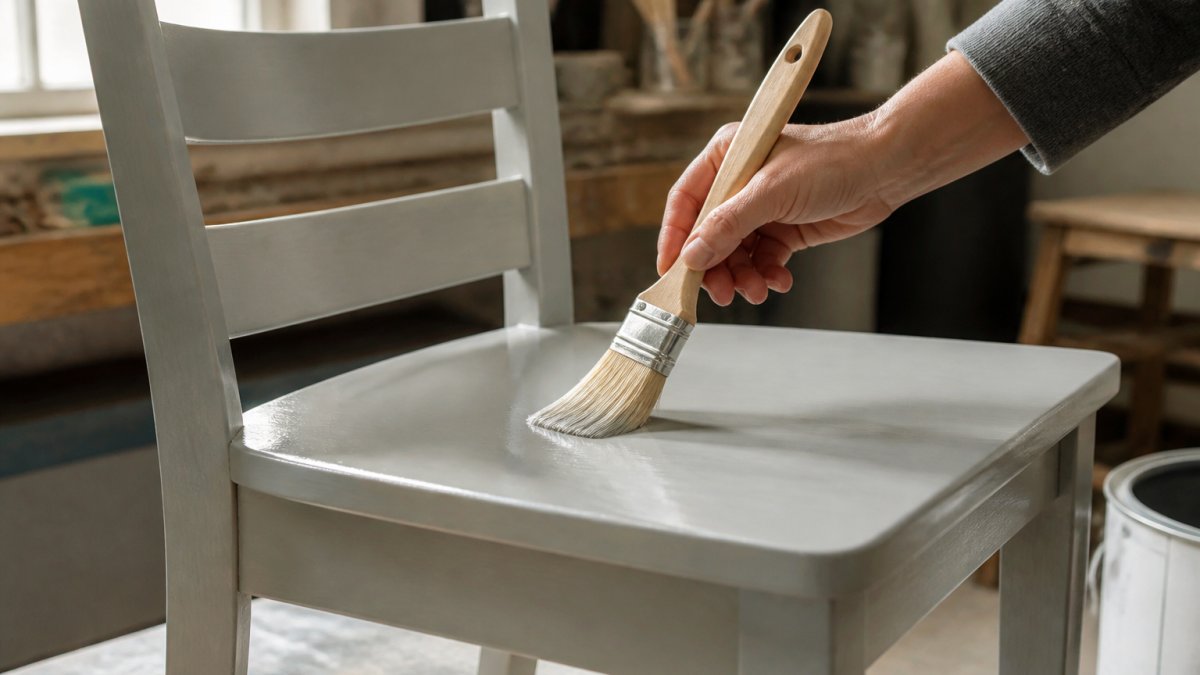
It comes in flat or satin and applies with a synthetic bristle brush or microfiber roller.
Ultra Guard goes on whitish and dries completely transparent, so there's no cloudy cast on dark colors once cured.
The one drawback is timing: wait 6 to 8 hours before sanding between coats, and 3 to 48 hours between coats depending on conditions.
3. Gel Stain & Top Coat: One-Step Protection for Rough Surfaces
Gel Stain & Top Coat solves a different problem: surfaces too damaged to prep properly.

At $56.99, it's an option here, and it replaces both a stain and a separate topcoat. It comes in Patina (a clear amber tone), Black, Greystone, and Double Espresso.
The one-step format means fewer products, fewer steps, and less chance of a compatibility problem between layers.
Water-Based Topcoat for Furniture: Why It Wins on Light Painted Pieces
A water-based topcoat for furniture is the right default on light or white painted surfaces because it won't yellow the way oil-based finishes can. Yellowing is the slow amber shift that turns crisp white paint into dingy cream, and it shows up worst on light colors.
But "water-based is better" is too blunt. The two chemistries fail differently, and knowing which failure you can live with drives the choice.
Why Oil-Based Finishes Yellow
Oil-based polyurethane cures by oxidation: resins react with oxygen and cross-link into a hard film. That same reaction produces amber-colored byproducts that accumulate over months and years.
The effect is worse in low light and on north-facing pieces, because there's no UV to bleach the amber back out. A white piece finished in oil-based poly can look cream within a year and distinctly yellow within three.
Why Water-Based Finishes Stay Clear
Water-based topcoats cure by coalescence and evaporation rather than oxidation. The acrylic or polyurethane-acrylic resins fuse as water and co-solvents leave the film, leaving far less of the chemistry that produces amber byproducts.
This is why water-based finishes are the standard recommendation for white, off-white, pale gray, pastel, and any light color where a shift would be obvious. It's not marketing; it's cure chemistry.
Fusion Mineral Paint Tough Coat Topcoat Matte and Glossy →
The Trade-Offs You're Actually Accepting
Water-based isn't strictly superior. The honest comparison:
- Hardness and heat resistance: Oil-based films generally cure harder and resist hot mugs and standing water slightly better. Water-based finishes have closed most of that gap, especially silica-reinforced formulas, but a traditional oil-based poly still has an edge on a surface that regularly sees hot dishes.
- Solvent resistance: Oil-based finishes hold up better against harsh solvents and some strong cleaners. Water-based finishes can be softened by ammonia-heavy or alcohol-heavy cleaners if left to sit.
- Odor and indoor use: Water-based wins decisively. Oil-based solvents linger for days and are a poor choice in a nursery, bedroom, or any space without strong ventilation.
When to Choose Oil-Based Anyway
There are real cases where oil-based is the better call: a dark-stained piece where yellowing is invisible or desirable, a bar top or work surface that sees solvents and heavy heat, or a piece where the deeper amber tone is part of the intended look.
For everything else, white paint, light paint, indoor pieces, anything a child or pet touches, water-based is the safer default, and it's why all three finishes recommended above are water-based and non-yellowing.
How to Apply Topcoat to Furniture Without Brush Marks
Apply topcoat in thin, even coats with the right applicator, and never go back over a wet section. That single rule prevents most brush marks and bubbles.
A damp applicator sponge or lint-free cloth is easier to control than a brush for wipe-on finishes.
A few more details that matter:
- Wet your applicator and wring it out until just damp before loading it
- Work in straight lines, end to end, one direction only
- Keep your sponge in a ziplock bag between coats so it doesn't dry out
Furniture Topcoat Cure Time: When It's Safe to Use
Furniture topcoat cure time matters more than most people expect, because a finish dry to the touch is not yet fully cured. Dry time is when the surface stops feeling tacky; cure time is when the finish has fully hardened and reached maximum durability.
The useful question is what you can actually do with the piece at each stage, because "cured" is not a single moment, it's a progression.
Dry, Recoat, Handle, Cure: Four Different Milestones
A water-based topcoat passes through four stages, each unlocking a different level of use:
- Dry to touch (30 minutes to 2 hours): The surface no longer feels tacky. Dust may settle on it, but you cannot handle the piece without leaving marks.
- Recoat window (2 to 8 hours for most water-based products): The film is firm enough to accept another coat and still soft enough to bond chemically with it. Miss the window and you'll need to scuff-sand before recoating.
- Handle-able (24 to 48 hours): You can move the piece, flip it, and install hardware. The finish will still mar under a fingernail pressed hard into it.
- Fully cured (5 to 30 days): The film reaches maximum hardness, scratch resistance, and chemical resistance. This is when the durability claims on the label actually apply.
The gap between stage three and stage four is where most finishes get blamed unfairly. A table that scratches in week one isn't a bad product; it's a finish put into service before it finished hardening.
Realistic Timelines by Piece
A practical schedule for a water-based topcoat in normal indoor conditions (roughly 20 to 22°C and moderate humidity):
- Decorative shelf or dresser top: 48 hours before light use, 7 days before normal use.
- Dining table or kitchen island: 7 days before meals, 14 to 30 days before heavy daily use with hot dishes and cleaning sprays.
- Chairs and stools: 72 hours before sitting, 14 days before daily use. Chair seats and backs take concentrated abrasion and body oils.
What Slows Cure Down
Cure time is not fixed. It stretches under predictable conditions:
- Humidity above roughly 60%: Water-based films need moisture to leave the film. High humidity can double or triple cure time.
- Cold rooms below about 18°C: Cool temperatures slow coalescence and can leave a film that never fully hardens.
- Thick coats: A heavy single coat cures from the outside in, trapping solvent underneath. Two thin coats always cure faster and harder than one thick one.
How to Test Whether It's Actually Cured
You don't need a lab. Two field tests work well:
- The fingernail test: Press a fingernail firmly into an inconspicuous spot. If it leaves a dent that doesn't spring back, the film is still soft. Repeat every few days.
- The coin test: Drag the edge of a coin across a hidden area with light pressure. A cured film resists; a soft film scuffs or whitens.
Neither test is destructive if you use a hidden spot, and both beat guessing from the calendar.
Why This Matters More on High-Traffic Pieces
On a decorative shelf, an under-cured finish is a minor annoyance. On a dining table, it's the difference between a finish that survives a year of family meals and one scratched and cloudy by month two.
If you remember one rule: give any water-based topcoat on a high-traffic piece a full week of gentle use before treating it as finished, and two to four weeks before cleaning it with anything stronger than a damp cloth.
Frequently Asked Questions
What is the best topcoat for a dining table that gets used every day?
For daily-use dining tables, Fusion Ultra Guard works best. Its water-based polyurethane formula is reinforced with silica for abrasion resistance, so it handles plates, cutlery, and constant wiping better than a standard sealer. Apply two coats over painted surfaces, waiting 3 to 48 hours between coats. For bare wood or non-sealing stains, three coats give the best protection. Ultra Guard is non-yellowing, which matters on light or white paint.
How many coats of topcoat should I apply to high traffic furniture?
Two coats is the standard for painted surfaces. Fusion Tough Coat recommends two coats applied 2 to 4 hours apart. Ultra Guard also calls for two coats on painted furniture, but bumps that to three coats on bare wood or non-sealing stains. More coats add wear resistance, but each coat needs proper drying time before the next. Rushing the recoat window is the most common reason a finish fails early.
How long should a furniture topcoat cure before regular use?
Dry time and cure time are different. Tough Coat dries in 2 to 4 hours between coats, and Ultra Guard allows 3 to 48 hours between coats. Full cure takes longer, often several days to a week depending on humidity and temperature. During cure, the finish is still hardening. Avoid heavy use, hot dishes, and harsh cleaners during this window. In humid conditions, extend all drying and curing times.
Will a water-based topcoat yellow over white painted furniture?
Water-based topcoats are non-yellowing, which makes them the safer choice over white or light-colored paint. Oil-based polyurethane tends to amber over time, especially in rooms with less natural light. Fusion Tough Coat and Ultra Guard are both water-based and non-yellowing. Ultra Guard goes on whitish and dries transparent, so it enhances both light and dark colors without shifting the tone of your paint.
Can I apply a topcoat over laminate or previously painted furniture?
Yes, with the right product. Fusion Gel Stain & Top Coat is designed for surfaces in rough shape, including laminate, melamine, pre-painted wood, and chipped milk-painted pieces. It adds color and protection in one step with minimal prep. For standard painted surfaces, clean and degrease with a TSP alternative first, then wait 24 to 48 hours after painting before applying Ultra Guard or Tough Coat.
Getting a finish to hold up on a tabletop or a set of kitchen chairs comes down to matching the topcoat to the abuse it will take, applying thin coats, and giving it time to cure. That's the whole game. Regained Relics carries the full lineup, including Tough Coat, Ultra Guard, and Gel Stain & Top Coat, plus the applicator sponges that make a streak-free finish much easier to achieve. Browse our DIY supplies and get free shipping on orders over $100, or save 10% on your first order.